5 Automation Shortcuts That Save Tulsa Businesses Time and Money

5 Automation Shortcuts That Save Tulsa Businesses Time and Money

What would your business look like if your best people had an extra day each week to focus on clients, strategy, or growth? That’s not a stretch goal – it’s the real-world result one accounting firm saw after automating a single manual process that had been part of their routine for years. No new hires. No big overhaul. Just 300 hours a year quietly handed back.

Here’s the thing: your most valuable employees are probably spending part of their week on work that doesn’t need them. Not because they’re underperforming  – because no one has stopped to ask whether a computer should be doing it instead. As a managed IT services provider in Tulsa, we see this scenario play out every week-businesses losing time not because they lack talent, but because their systems aren’t doing enough of the work for them.

The good news? You don’t need a massive IT project to start fixing it. The automations that deliver the biggest return are usually small, practical shortcuts that quietly remove friction from everyday work.

One thing worth knowing, though: automation amplifies whatever foundation you already have. If your tools aren’t connected or your processes are fuzzy, automation can create just as much chaos as it prevents. That’s why starting with a solid IT foundation – and the right managed IT partner  – makes all the difference between automation that helps and automation that just adds another thing to manage.


Where Time and Money Slip Away

If you traced your team’s day from start to finish, you might be surprised by how much of it is spent on work that doesn’t need to exist.

It rarely shows up as one big problem. It’s a dozen small ones.

By midafternoon, someone’s already entered the same client information twice. A new hire is still waiting on system access because onboarding steps are scattered across three people’s to-do lists. An approval that should’ve taken five minutes has been sitting in an inbox since morning.

Individually, these moments feel like minor annoyances. Together, they slow your team down, add to payroll costs, and pull your best people away from the work they were hired to do. In healthcare practices, law firms, and energy companies across Tulsa and Oklahoma City, this kind of quiet drag adds up to thousands of dollars a year  – often without leadership ever connecting the dots.

This is exactly where managed IT services in Tulsa can move the needle – especially when automation is built on a reliable, well-managed IT foundation.


5 Automation Shortcuts That Pay Off

The automations that deliver the best results aren’t the flashiest ones. They’re the ones that target work your skilled employees shouldn’t be doing in the first place.

Here’s where we see the most immediate payoff for businesses like yours.


Shortcut #1: Eliminate Duplicate Data Entry

If your team is entering the same patient, client, or vendor information into more than one system, you’re quietly absorbing costs every single day. Manual re-entry doesn’t just eat time – it introduces errors that someone else must catch and clean up later.

When systems share data automatically, you cut the repetition and improve accuracy at the same time. It’s one of the simplest changes with some of the most immediate results.

Business impact: Reclaim billable hours, reduce rework, and make decisions based on information you can trust.


Shortcut #2: Streamline Common Internal Requests

Think about how often someone on your team must stop what they’re doing to handle a password reset or push through an access request. Each one takes maybe ten minutes. Multiply that across a week, and it adds up fast  – and that’s before you factor in the focus lost every time someone gets pulled off a real task.

Simple automation lets those routine requests move through the right channels without anyone having to babysit them.

Business impact: Faster response times, less daily friction, and more mental bandwidth for your team to get things done.


Shortcut #3: Automate Onboarding and Offboarding

Nobody enjoys a chaotic first week. And nobody wants to find out that a former employee still has access to systems three weeks after they left.

When onboarding and offboarding rely on scattered checklists and individual memory, steps get missed. In regulated industries like healthcare and legal services, those gaps can create real compliance exposure. Automation makes the right things happen automatically, every time  – no one must remember to kick it off.

Business impact: Stronger security, less administrative scramble, and new hires who feel set up for success from day one.


Shortcut #4: Replace Manual Monitoring with Smart Alerts

If someone on your team is regularly checking dashboards just to make sure everything looks okay, that’s a lot of time spent waiting for something to go wrong.

Smart alerts flip that dynamic entirely. Your team isn’t watching systems anymore – they’re only notified when something truly needs their attention.

Business impact: Less wasted time on routine checks and a much faster response when something real comes up.


Shortcut #5: Standardize Repetitive Processes

When routine tasks get handled differently depending on who’s available or who remembers the steps, inconsistency creeps in. Eventually, it reaches your customers – and that’s when it becomes a bigger problem than just an internal headache.

Automation keeps things consistent. The same steps, the same way, every time.

Business impact: More predictability, a lighter training load, and fewer of those “how did this slip through?” moments.


How to Spot Your Best Automation Opportunities

You don’t have to be a technology expert to figure out where your biggest opportunities are. In most businesses, they’re not hidden – they just haven’t been named yet.

For many Tulsa businesses, working with a local MSP in Tulsa makes automation simpler and more effective. A trusted managed services provider understands regional industries, compliance demands, and how to build systems that scale without unnecessary complexity.

A few good questions to start with:

  • Where does work tend to stall or slow down for no obvious reason?
  • What tasks does your team complain about most consistently?
  • Where do small mistakes happen because steps are handled manually?

The answers almost always point to repeatable processes that follow clear rules. Those are your best starting points – and usually the easiest wins.

The goal isn’t to automate everything. It’s to stop spending skilled time on work that doesn’t need skilled attention.


Why the Right Managed IT Partner Makes All the Difference

Here’s something we hear often: businesses know they should be automating more, but they’re not sure where to start – and they don’t want to make things more complicated than they already are.

That’s a completely fair concern. Automation done poorly really can create more work. But automation done right? It quietly makes everything a little easier, week after week.

At Nomerel, we don’t walk in with a list of tools to sell you. We start by understanding how work flows through your business – where the friction lives, where the manual steps are hiding, and what your team is tolerating because it’s just become normal. From there, we help you simplify before you automate, so the improvements stick.

We work with businesses across Tulsa, Oklahoma City, and the surrounding region as their managed IT services partner – and this kind of operational clarity is one of the things we love helping with most.


Wondering Where You’re Losing Time?

Automation isn’t about chasing the latest technology trend. It’s about getting your team’s time back and removing the small frustrations that add up to big costs over the course of a year.

The best improvements aren’t loud. They just work – quietly, consistently, in the background. But getting there starts with a clear-eyed look at your IT environment and an honest conversation about what’s slowing you down.

If you’re evaluating managed IT services in Tulsa or considering a new MSP partner, automation is one of the clearest ways to unlock value quickly – when it’s done right.


We’d love to have that conversation with you. Reach out to our team at sales@nomerel.com or call 918-770-4099 to schedule a free, no-obligation consultation. We’ll help you identify where automation can make the biggest difference – and make sure your foundation is ready to support it.


FAQ
Q: What is business process automation and does my business need it?

Business process automation means using technology to handle repetitive, rule-based tasks — things like data entry, routing requests, or sending notifications — without requiring manual effort. If your team is regularly spending time on the same steps week after week, there’s a good chance automation could give that time back. Most small and mid-sized businesses in Tulsa have more automation opportunities than they realize, and many don’t require a large investment to get started.

Q: How much time can automation realistically save my business?

It varies by business, but the results are often surprising. A single automated process — like eliminating duplicate data entry or streamlining onboarding — can recover dozens of hours per employee each year. One accounting firm we reference in this post reclaimed over 300 hours annually by automating just one manual step. Across a full team, those savings add up quickly.

Q: What tasks or processes should I automate first?

Start with work that is repetitive, follows a clear set of rules, and doesn’t require judgment or creativity. Common starting points include data entry between disconnected systems, internal IT requests like password resets, employee onboarding and offboarding, and routine monitoring and alerts. A managed IT partner can help you identify where the biggest time and cost savings are hiding in your specific environment.

Q: Is automation only practical for large businesses with big IT budgets?

Not at all. In fact, small and mid-sized businesses often see the fastest and most noticeable returns from automation because manual processes make up a larger share of daily operations. Many of the most impactful automations are built into tools businesses already use — like Microsoft 365 — and just need to be properly configured. A managed IT services provider can help you get value from the technology you’re already paying for.

Q: How does a managed IT partner help with business automation?

The biggest challenge with automation isn’t the technology — it’s knowing what to automate and in what order. A managed IT partner like Nomerel starts by understanding how work flows through your business, identifying where manual effort is creating drag, and helping you simplify before adding automation. This ensures that new automations actually stick and improve operations rather than adding complexity. If you’re based in Tulsa, Oklahoma City, or the surrounding area, our team is ready to help you get started.

Mark Rush

Mark Rush

Co-author, Founder & CEO of Nomerel

Mark founded Nomerel on a straightforward premise: businesses deserve technology that works — reliably, securely, and without disruption. With over 40 years of experience in IT leadership and managed services, he has guided organizations of all sizes through modernization initiatives, cybersecurity challenges, and complex infrastructure decisions. Mark is known for his calm, strategic approach and his ability to help clients cut through the noise and make confident, well-informed technology decisions. His focus has always been on building lasting partnerships rooted in trust, reducing risk, and ensuring technology becomes a strength — not a source of stress — for the businesses he serves.

Faith Morgan

Faith Morgan

Co-author, Marketing Coordinator at Nomerel

Faith is a dynamic marketing professional with over 9 years of experience in content marketing, social media strategy and video production. An avid traveler and outdoor enthusiast, she draws inspiration from exploring new places, enriching her storytelling approach. At Nomerel, she enhances communication, streamlines processes, and supports the company’s mission to provide exceptional IT solutions.

Storm Season Is Here: Why Managed IT Services in Tulsa Suggest You Declutter Your Tech

Storm Season Is Here: Why Managed IT Services in Tulsa Suggest You Declutter Your Tech

Spring in Oklahoma means two things: severe weather season and the undeniable urge to clean things out.

Businesses across Tulsa and Oklahoma City are used to preparing for the unexpected this time of year — stocking up on supplies, checking emergency plans, making sure the important things are in order before a storm rolls in. But there’s another kind of preparation that gets overlooked every spring, and it’s one that quietly affects your bottom line every single day.

Cleaning up your technology environment.

Most businesses assume that better results come from buying something new — another tool, another platform, another promise of improved efficiency. But when technology isn’t delivering the return you expected, the problem is rarely that you need more. More often, it’s that too much is already in the way.

ROI isn’t always found in the next purchase. Sometimes it’s uncovered by clearing out what’s already there.


How Tech Clutter Builds — And Why No One Notices

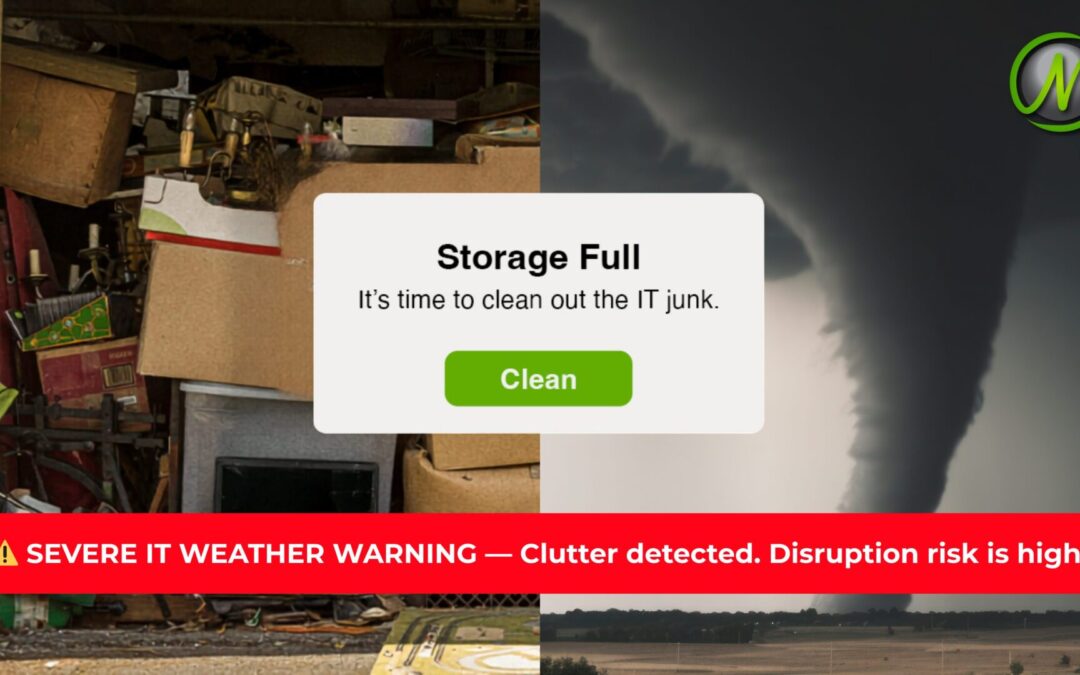
Think about that one closet in your office. The door closes fine. Nothing falls out when you walk by. But open it, and you’ll find layers of things accumulated over years — each item added for a reason, none of them removed.

Technology environments work the same way.

A new tool gets added to solve a specific problem. A platform comes in as the business grows. A workaround gets created during a busy stretch and never revisited. An older system stays in place because nobody wants to risk touching something that still technically works.

Each decision made sense at the time. The problem is that those decisions are rarely reviewed together. Nothing is visibly broken, so there’s no urgency to simplify. Over time, a series of reasonable choices quietly turns into a web of complexity — and that complexity costs you more than most business owners realize.

This is one of the first issues we at Nomerel evaluate – because unmanaged accumulation quietly erodes performance, security, and ROI over time.


Five Areas Where Decluttering Delivers Measurable ROI

Technology clutter rarely causes dramatic failures. What it causes is friction — small, persistent delays that are easy to overlook individually but add up significantly over time. Here’s where that friction shows up, and what cleaning it up returns to your business.


ROI Area #1: Time Reclaimed

When tools overlap and workflows aren’t clearly defined, people lose time in ways that are hard to quantify but easy to feel. Switching between systems, double-checking information across platforms, creating workarounds just to get through the day — it adds up fast.

Decluttering removes those extra steps. When your team knows exactly where work happens and which system to rely on, tasks move faster, onboarding becomes easier, and projects flow more smoothly from start to finish.

A few minutes saved per person per day compounds into hours across the business every week. Time reclaimed is one of the most underestimated returns in technology.


ROI Area #2: Reduced and More Predictable Costs

Technology clutter hides quiet expenses that rarely show up as a single line item. Unused software licenses that keep billing every month. Overlapping tools that were never consolidated. Systems that stay in place long after they’ve outlived their value.

Then there are the surprise costs — emergency fixes, unplanned support calls, and the kind of scramble that happens when an outdated system fails without warning. For small and mid-sized businesses in Tulsa and Oklahoma City, unpredictable IT costs are one of the most common frustrations we hear from business owners.

Decluttering brings spending back under control. Costs become clearer and more predictable. Money stops leaking in places that no longer add value.


ROI Area #3: Lower Risk and Fewer Surprises — Especially Heading Into Storm Season

Complex, cluttered IT environments create uncertainty. When it isn’t clear how systems connect to one another, even small changes feel risky. And when something does go wrong — whether it’s a ransomware attempt, a system failure, or a severe weather event that forces your team to work remotely — recovery is harder when no one fully understands what’s running.

Oklahoma’s spring storm season is a real reminder that disruptions don’t announce themselves. Tornado warnings don’t wait for a convenient time, and neither do cyberattacks or hardware failures. For legal firms protecting confidential client data, healthcare practices maintaining HIPAA compliance, and energy companies depending on operational uptime, a cluttered IT environment isn’t just inefficient — it’s a liability when the pressure is on.

Simplifying your environment reduces those blind spots. With clearer ownership and fewer overlapping systems, your business is better positioned to respond — whatever the disruption.

Local businesses working with managed services providers in Tulsa often discover that storm readiness isn’t just about backups—it’s about clarity. When systems are simplified and documented, recovery is faster, decisions are clearer, and chaos is reduced when weather or cyber events strike.


ROI Area #4: Better Decisions and Growth Readiness

Leaders make better decisions when they can see clearly how everything fits together. When your technology environment feels complicated or poorly understood, scaling feels risky. Hiring feels more complicated. Expanding operations feels uncertain because you’re not sure how your systems will hold up under pressure.

That uncertainty slows progress — even when the business opportunity is right in front of you.

Decluttering restores confidence. When you understand what your business relies on, you can plan ahead, evaluate new tools with clarity, and make growth decisions without second-guessing your foundation.


ROI Area #5: Happier, More Productive Teams

Technology shapes how your team experiences their work every single day. When systems are cluttered and unclear, frustration builds quietly. Focus shifts away from meaningful work toward the effort of navigating tools that create more friction than they remove.

When technology facilitates action instead of getting in the way, teams are free to do their best work. And that freedom — the ability to focus, move quickly, and make confident decisions — is one of the most powerful returns any business can achieve.


What Decluttering Is — and What It Isn’t

Spring cleaning your IT environment is not a rip-and-replace project. It doesn’t mean starting over or disrupting what already works.

It means stepping back and reviewing what you have with fresh eyes. Simplifying where tools overlap. Organizing what remains. Retiring what no longer serves the business. Addressing quiet risks before they become active problems.

Small improvements can deliver meaningful returns. And unlike a major technology overhaul, decluttering is about clarity — not disruption.


How Nomerel Can Help Increase Your ROI

Every spring cleaning project starts the same way: opening the door and seeing what’s truly inside.

Technology ROI works the same way. The first step isn’t buying something new — it’s gaining visibility into what’s already there. When business owners take that closer look, they often discover that the strongest returns come from simplifying, not stacking more on top of what’s already there.

You can’t measure the return on clutter you haven’t cleaned up yet.

At Nomerel, we help small and mid-sized businesses across Tulsa, Oklahoma City, and throughout Oklahoma gain that visibility — and turn it into a cleaner, more secure, and more cost-effective IT environment. Whether it’s identifying unused tools, addressing compliance gaps, or simply making sense of what’s running in your environment, our team provides the kind of straightforward guidance that removes uncertainty and supports growth.

Ready to see what’s in your IT closet? If you’re evaluating managed IT service providers in Tulsa or wondering whether your current environment is truly supporting your growth, an IT Business Review can help you identify quick wins, hidden risks, and real opportunities to simplify.

Contact Rhonda Rush to schedule a no-pressure call at Rhonda.Rush@Nomerel.com or call (918) 770-4099.


FAQ About Managed IT Services in Tulsa
What are managed IT services, and how do they help Tulsa businesses?

Managed IT services provide ongoing support, monitoring, and strategic guidance for a company’s technology environment. For businesses in Tulsa, managed IT services help reduce downtime, control costs, improve security, and ensure systems are prepared for disruptions like severe weather, cyber threats, or unexpected growth. Rather than reacting to problems, managed IT services focus on prevention, clarity, and long-term stability.

Why do managed IT services in Tulsa emphasize decluttering technology systems?

Managed IT services providers in Tulsa frequently recommend decluttering because excess tools, outdated systems, and overlapping platforms quietly drain time and money. Simplifying technology improves performance, reduces risk, lowers support costs, and makes it easier to recover during outages or storm-related disruptions. Decluttering often uncovers ROI faster than buying new technology.

How does spring storm season impact IT planning for Tulsa businesses?

Spring storm season in Oklahoma increases the risk of power outages, internet disruptions, remote-work shifts, and data loss. Managed IT services Tulsa companies focus on preparedness by ensuring systems are documented, backed up, and easy to recover. A simplified IT environment makes it far easier to respond quickly when severe weather forces sudden operational changes.

What’s the difference between managed IT services and break-fix IT support?

Break-fix IT support responds after something goes wrong. Managed services Tulsa providers take a proactive approach by monitoring systems, addressing risks early, and continuously improving the environment. This proactive model reduces surprises, creates predictable costs, and supports better business planning—especially during high-risk periods like storm season.

Can managed services help reduce IT costs for small and mid-sized businesses in Tulsa?

Yes. One of the biggest benefits of managed services Tulsa businesses experience is cost clarity. By eliminating unused software, consolidating tools, and addressing hidden inefficiencies, managed IT services reduce waste and prevent expensive emergency repairs. Over time, this leads to more predictable budgeting and better ROI.

How do managed IT services support compliance and security?

Managed IT services in Tulsa help businesses maintain compliance by standardizing systems, applying consistent security controls, and closing gaps created by outdated or forgotten tools. A decluttered environment reduces blind spots, making it easier to protect sensitive data and respond confidently to audits or security incidents.

Is decluttering IT disruptive to daily operations?

No. Decluttering is not a rip-and-replace project. Managed IT services providers approach it carefully, reviewing what exists, simplifying where needed, and retiring unused systems without interrupting daily work. Most businesses find that the process reduces disruption rather than creating it.

How do I know if my business needs managed IT services in Tulsa?

If your technology feels complicated, costs are unpredictable, storm readiness is uncertain, or growth feels riskier than it should, it’s often a sign that managed IT services can help. Many Tulsa businesses start with an IT assessment or business review to identify quick wins, hidden risks, and opportunities to simplify before problems become urgent.

Mark Rush

Mark Rush

Co-author, Founder & CEO of Nomerel

Mark founded Nomerel on a straightforward premise: businesses deserve technology that works — reliably, securely, and without disruption. With over 40 years of experience in IT leadership and managed services, he has guided organizations of all sizes through modernization initiatives, cybersecurity challenges, and complex infrastructure decisions. Mark is known for his calm, strategic approach and his ability to help clients cut through the noise and make confident, well-informed technology decisions. His focus has always been on building lasting partnerships rooted in trust, reducing risk, and ensuring technology becomes a strength — not a source of stress — for the businesses he serves.

Faith Morgan

Faith Morgan

Co-author, Marketing Coordinator at Nomerel

Faith is a dynamic marketing professional with over 9 years of experience in content marketing, social media strategy and video production. An avid traveler and outdoor enthusiast, she draws inspiration from exploring new places, enriching her storytelling approach. At Nomerel, she enhances communication, streamlines processes, and supports the company’s mission to provide exceptional IT solutions.

Why More IT Tools Aren’t the Answer — and What Tulsa Businesses Need Instead

Why More IT Tools Aren’t the Answer — and What Tulsa Businesses Need Instead

When something breaks at work, the instinct is almost universal: find a tool that fixes it.

A backup solution here. A cloud storage app there. A security add-on that promises extra protection. Each decision feels reasonable in the moment. Over time, though, your IT environment starts to look less like a strategy and more like a junk drawer — full of tools that might help, but no one is quite sure which one does what.

For small and mid-sized businesses in Tulsa, this is one of the most common and costly IT mistakes we see.


The Problem Isn’t the Technology. It’s the Uncertainty.

Picture a busy morning at your office. A deadline is close, a client is waiting, and the day feels like it’s on track. Then someone can’t find the file they just saved. A screen freezes. A task that should take minutes comes to a halt.

No one panics. People try a quick fix or move on to something else. The moment passes.

But the rhythm is broken — and those small disruptions add up faster than most business owners realize.

The real problem rarely shows up in the glitch itself. It shows up in the pause that follows, when no one knows what to do next. Who handles this? Where do we start? Whose job is this?

While those questions are being answered, work stays paused. For legal, healthcare, and energy businesses in Tulsa that depend on reliable uptime to serve clients, stay compliant, and protect sensitive data, that pause can be more costly than it appears.


More Tools Usually Means More Confusion

It’s easy to buy technology for hypothetical problems. It’s harder to build confidence for the ones that show up — on your busiest day, during a deadline, when a key person is out of the office.

When businesses accumulate too many disconnected tools, things can appear to run fine on a normal day. The trouble surfaces when something breaks. Suddenly, no one is sure which system to check first, who has access, or whether the last backup suceeded.

That uncertainty is already costing you more than you realize — even if you haven’t experienced a significant incident yet.


What a Managed IT Partner Does Differently

This is where working with a managed IT provider changes the experience entirely.

Instead of managing a collection of tools that were purchased over time and never properly integrated, there’s clear accountability. Systems are set up correctly, tested, and ready before they’re ever needed. Responsibilities are defined. Recovery processes are documented and practiced.

When something goes wrong, there’s no scramble. No one has to guess what happens next. The problem is contained quickly, before it has a chance to affect your clients, your team’s productivity, or your compliance standing.

For businesses in regulated industries — healthcare organizations managing HIPAA requirements, legal firms protecting sensitive client data, or energy companies navigating industry-specific compliance — that kind of structure isn’t optional. It’s essential.


What “Handled” Looks Like in Practice

Here’s what proactive, managed IT looks like in day-to-day life for a Tulsa business:

A file disappears. It’s restored quickly — no panic, no scramble, and no guessing which system to check. At Nomerel, we maintain reliable backup systems so that files can be recovered fast, minimizing the impact on your team and keeping client deliverables on track.

An update causes unexpected issues. Your team stays productive while the problem is addressed in the background. Our engineers proactively monitor your systems and can often identify and resolve update conflicts before your team even notices something is wrong. Work doesn’t come to a halt waiting for someone to figure out what happened.

A workstation fails. Continuity is maintained. Nomerel’s team helps manage your hardware lifecycle proactively — meaning we’re already tracking aging equipment and flagging it before it becomes an emergency. When a device does go down, any authorized user on your staff can simply call our Nomerel Support Line for immediate assistance, rather than waiting hours for someone to respond.

Something suspicious happens. There’s a clear, immediate response — not a period of uncertainty about whether the situation is serious or who should handle it. Nomerel’s cybersecurity services include live monitoring of your environment, so threats are identified quickly, and your team has clear guidance on next steps to protect sensitive data and maintain compliance.

And because problems don’t always wait for business hours, Nomerel provides access to a 24/7 helpdesk. Whether an issue surfaces at 7 AM before a client meeting or later in the evening when your team is wrapping up, help is available when you need it — not just when it’s convenient.

The goal isn’t perfection. Every system will experience an issue eventually. The goal is recovery that’s fast, predictable, and doesn’t pull your attention away from running your business.


Predictable IT Is Good for Business

At Nomerel, one thing we hear consistently from business owners across Tulsa and the surrounding areas is this: they don’t want to think about IT.

They want to focus on their clients, their teams, and their growth — and they want to trust that their technology is working the way it should. They want predictable billing, not surprise invoices. They want a partner who is accountable, not a list of vendors to call when something breaks.

That’s exactly what a managed IT relationship is designed to provide.

The businesses that perform best aren’t the ones with the most technology. They’re the ones that can absorb disruptions without losing momentum — because someone has already thought through the what-ifs and built a response plan before anything goes wrong.


Is Your Current Setup Leaving You with Unanswered Questions?

If you’re not confident in how quickly your business could recover from an unexpected IT problem, that’s worth paying attention to.

At Nomerel, we help small and mid-sized businesses across Tulsa, Oklahoma City, and throughout Oklahoma replace IT uncertainty with a clear, proactive strategy. From managed IT services and cybersecurity to business continuity planning and compliance support, our team is built to keep your business moving — no scramble required.

Reach out to our team at Sales@Nomerel.com or call (918) 770-4099 to start a conversation about what “handled” really looks like for your business.


Mark Rush

Mark Rush

Co-author, Founder & CEO of Nomerel

Mark founded Nomerel on a straightforward premise: businesses deserve technology that works — reliably, securely, and without disruption. With over 40 years of experience in IT leadership and managed services, he has guided organizations of all sizes through modernization initiatives, cybersecurity challenges, and complex infrastructure decisions. Mark is known for his calm, strategic approach and his ability to help clients cut through the noise and make confident, well-informed technology decisions. His focus has always been on building lasting partnerships rooted in trust, reducing risk, and ensuring technology becomes a strength — not a source of stress — for the businesses he serves.

Faith Morgan

Faith Morgan

Co-author, Marketing Coordinator at Nomerel

Faith is a dynamic marketing professional with over 9 years of experience in content marketing, social media strategy and video production. An avid traveler and outdoor enthusiast, she draws inspiration from exploring new places, enriching her storytelling approach. At Nomerel, she enhances communication, streamlines processes, and supports the company’s mission to provide exceptional IT solutions.

The Hidden Yet Preventable Causes of Business Downtime

The Hidden Yet Preventable Causes of Business Downtime

When businesses think about downtime, they often picture major events such as cyberattacks, severe weather, or a large-scale system failure.

While those scenarios do occur (especially with tornado season in Oklahoma!), they are not the most common causes of business disruption.

Many preventable causes of business downtime come from overlooked day-to-day technology habits, such as accidental mistakes, incomplete updates, aging hardware, or preventable security risks. Individually these problems seem minor, but when there is no fast recovery process in place, they can bring work to a halt.

Even a short interruption affects productivity, customer experience, and revenue. The true cost of downtime is not the event itself—it is the time employees are unable to work while the problem is resolved.

Below are several of the most common yet preventable causes of downtime for small and midsize businesses.


The Small Issues That Cause Big Disruptions


Device Damage from Everyday Accidents

A spilled drink or dropped laptop can quickly take a workstation offline.

When a device fails unexpectedly, the employee loses access to email, applications, and files until the device is replaced and their data is restored. Without reliable backups or a quick replacement process, this type of incident can disrupt an employee’s productivity for hours or even days.

A liquid spill does not always cause an immediate device failure. In many cases, the system may appear to function normally at first. However, moisture inside a device can slowly corrode internal components and circuitry over time. This gradual damage often leads to intermittent issues—slower performance, random shutdowns, or hardware failure weeks or even months later. What appears to be a minor incident can quietly degrade critical components until the device ultimately fails.

The issue is rarely the accident itself. The real disruption comes from the time required to recover.


Accidental File Deletion

Human error remains one of the most common causes of business interruptions.

A file may be deleted, overwritten, or moved from a shared location without anyone noticing. The problem often surfaces only when the file is urgently needed for a client deliverable, financial report, or operational task.

When recovery options are limited, teams may spend hours searching for previous versions or recreating work from scratch. What should be a simple restore can quickly become a significant delay.

Reliable file backup and version history are critical to minimizing the impact of these mistakes.


Updates That Were Never Fully Installed

At Nomerel, our team frequently sees performance and security issues caused by updates that were downloaded but never fully installed. Many patches cannot complete the install process until a device is restarted.

When employees postpone restarts for extended periods, updates remain incomplete. This can lead to inconsistent system performance, unresolved vulnerabilities, and software conflicts.

Eventually, the system forces an update at an inconvenient time or begins experiencing performance issues, both of which can interrupt business operations.

At Nomerel, we highly recommend restarting your machine at the end of the day to ensure that all updates are completed promptly.  Restarting clears temporary files and cached processes that accumulate over time, allowing the system to start fresh and operate more efficiently.  It is a simple but important step in preventing avoidable downtime.


Poor Password and Email Security Practices

Security habits can also contribute to operational disruptions.

Employees sometimes use their work email address to register for personal services or reuse the same password across multiple accounts. If one of those external services experiences a data breach, those credentials can be exposed online.

Cybercriminals frequently test stolen credentials against business systems. If the same password is used for corporate accounts, attackers may gain access to company email or internal platforms.

Even a brief account compromise can disrupt communication, expose sensitive information, and require significant time to remediate.

Strong password policies and security controls significantly reduce this risk.


Aging Hardware Failures

All hardware eventually reaches the end of its lifecycle.

Computers, servers, and network equipment become slower and less reliable as they age. When aging equipment fails unexpectedly, businesses must quickly find replacements, reinstall software, and restore data.

Without a hardware lifecycle plan or recovery process, this can result in extended downtime and lost productivity.

Proactive equipment management helps prevent these disruptions before they occur.


The Real Problem: Delayed Recovery

Across all these scenarios, the outcome is the same.

Employees cannot access the tools they need to work. Projects stall. Customer requests go unanswered.

The original problem may be small, but the business impact grows quickly when recovery is slow.

Downtime is ultimately a business continuity issue. The faster a company can restore systems, files, and devices, the smaller the disruption.


Why Fast Recovery Matters

While no organization can eliminate every potential problem, the goal is to recover as quickly and predictably as possible when something does arise.

When businesses have reliable backups, device replacement plans, and well-managed systems, most incidents become minor interruptions rather than major disruptions.

Fast recovery protects productivity, reduces stress for employees, and prevents small issues from affecting customers.


Make Downtime a Non-Issue

If you are unsure how quickly your business could recover from a situation like the ones described above, it may be time to evaluate your current systems and processes.

At Nomerel, we help businesses across Tulsa, Oklahoma City, and throughout Oklahoma reduce downtime by improving backup systems, device management, cybersecurity practices, and recovery planning.

A short conversation can often reveal simple improvements that significantly reduce operational risk.

Reach out to our team at Sales@Nomerel.com to review your current setup and ensure your business can recover quickly when unexpected issues occur.


Rhonda Rush

Rhonda Rush

Co-author, Director of Operations at Nomerel

Rhonda serves as Director of Operations at Nomerel, where she ensures every part of the organization—from service delivery to internal processes—runs smoothly and consistently. With a strong background in business operations, human resources, and organizational leadership, Rhonda brings a thoughtful, people-first approach to maintaining high service standards and a positive company culture. She holds both PHR and SHRM-CP certifications and is known for her commitment to clear communication, accountability, and attention to detail. Simply put, Rhonda is the glue that helps hold Nomerel together and keeps everything moving in the right direction.

Faith Morgan

Faith Morgan

Co-author, Marketing Coordinator at Nomerel

Faith is a dynamic marketing professional with over 9 years of experience in content marketing, social media strategy and video production. An avid traveler and outdoor enthusiast, she draws inspiration from exploring new places, enriching her storytelling approach. At Nomerel, she enhances communication, streamlines processes, and supports the company’s mission to provide exceptional IT solutions.